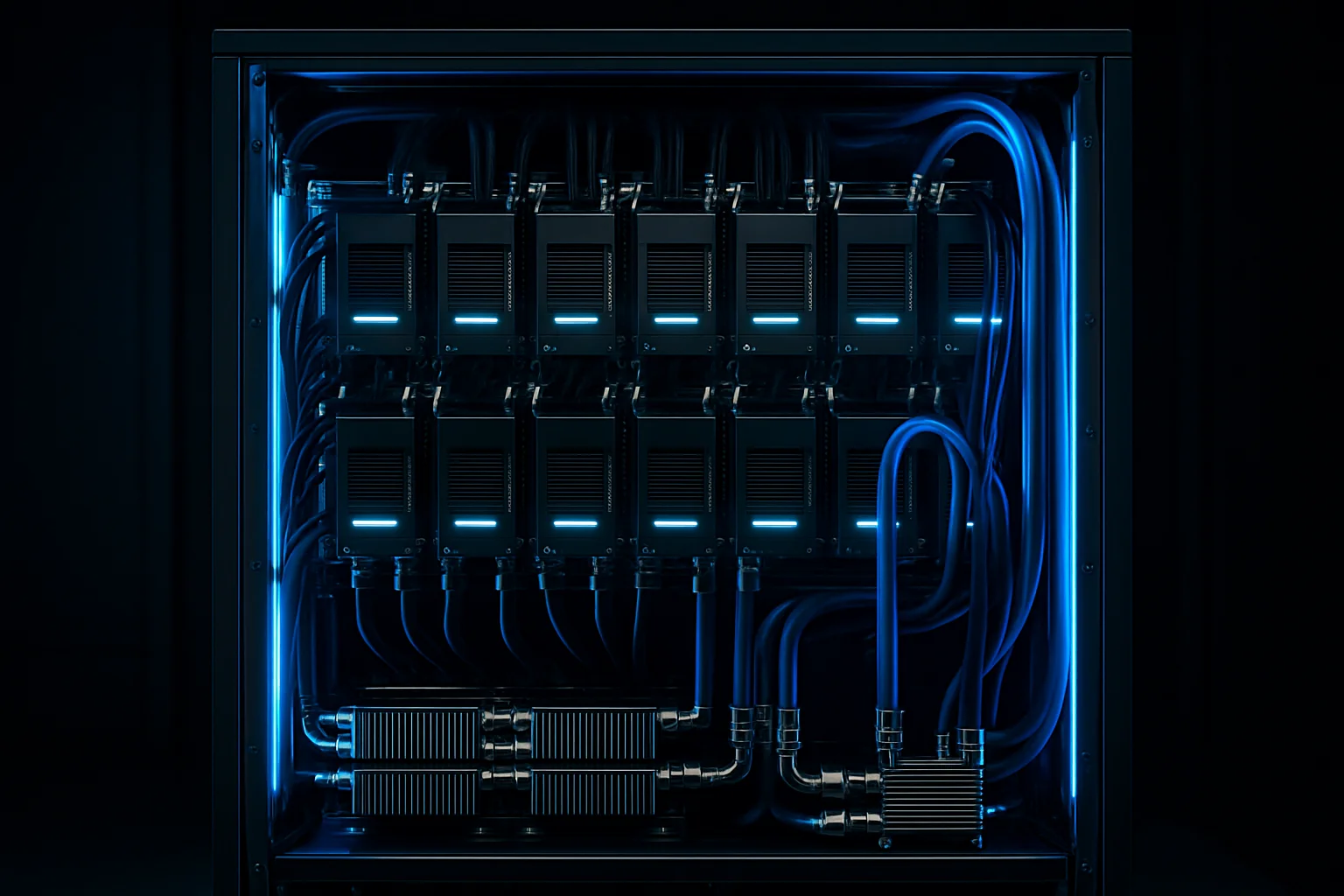
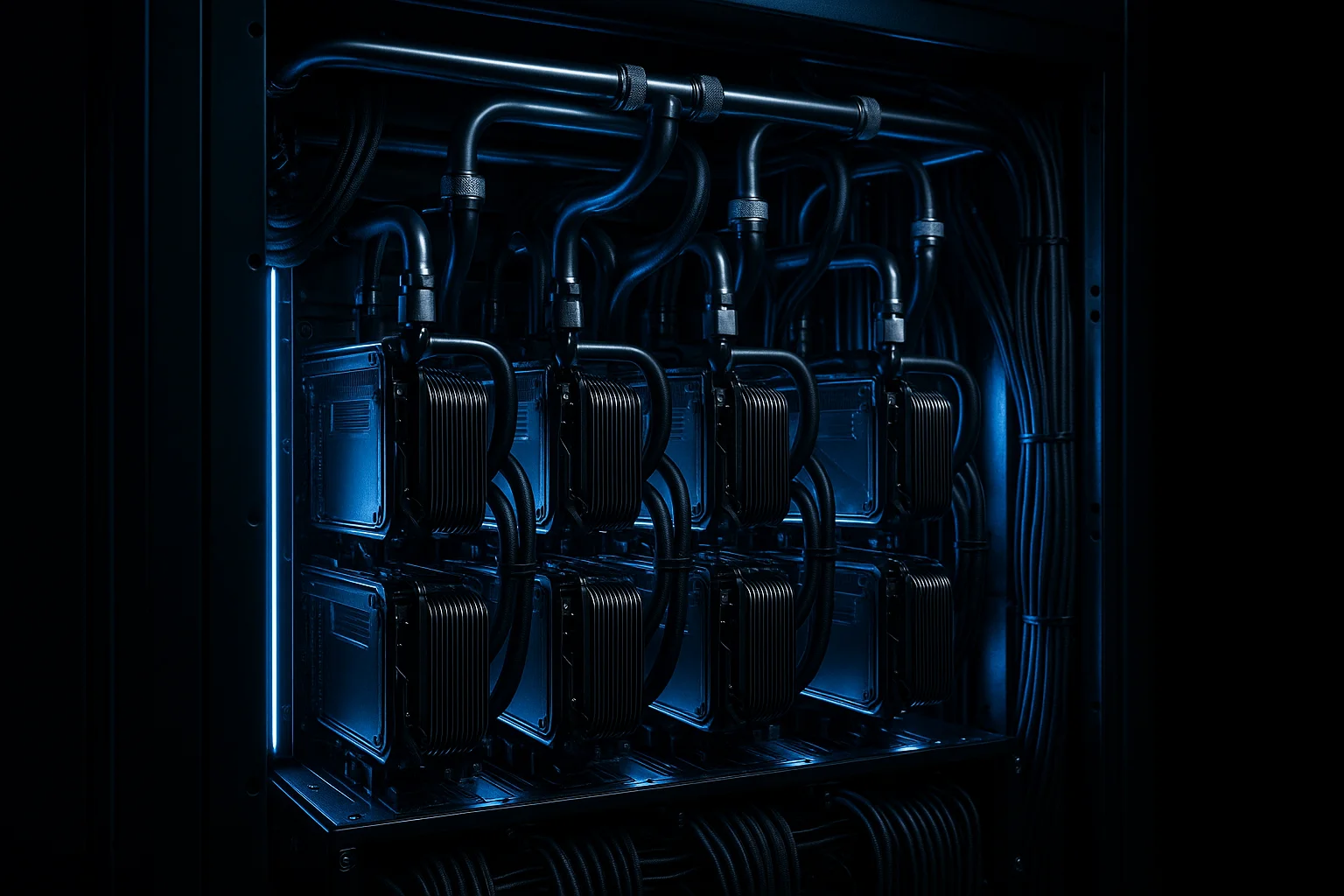
If you're planning an H100 or B200 cluster deployment for 2026, size your cabinet around 120kW direct-to-chip liquid cooling now — don't wait for groundbreak. IDACORE East is designed for 120kW/cabinet with true 2N power, targeting Q4 2026, priced at $175/kW/month plus utility pass-through, 1MW minimum commit.
Why Does 120kW Per Cabinet Matter Right Now?
Air-cooled GPU racks topped out around 15-20kW per cabinet a few years ago. That ceiling is gone. A single NVIDIA HGX H100 tray pulls close to 10kW, and when you pack eight GPUs plus networking and storage into a rack, you're at 40-60kW before you even think about density. B200 and next-gen Blackwell platforms push that higher still.
Air cooling can't move that heat out fast enough without absurd airflow volumes and CRAC tonnage that no facility can economically build at scale. Direct-to-chip liquid cooling is the only way to hit 100kW+ per cabinet without turning your data hall into a wind tunnel. That's why we designed IDACORE East around 120kW/cabinet from day one — not as a retrofit, but as the baseline spec.
If your cluster architecture assumes 120kW cabinets, you need a facility that was engineered for it, not one bolting liquid loops onto an air-cooled shell after the fact. That distinction matters more than people think when you're trying to hit a Q4 2026 go-live.
What Does True 2N Power Actually Mean Here?
A lot of colocation providers say "redundant power" and mean N+1 UPS with a diesel backup generator. IDACORE East is designed differently: independent grid source plus gas generation running as a true second path, not a backup that spins up during an outage. For a 5MW GPU cluster running a six or seven-figure training job, the difference between "backup power kicks in within 10 seconds" and "power never actually drops" is the difference between a blip and a corrupted checkpoint.
How Do You Plan Power Draw for a GPU Cluster This Size?
Here's the math IDACORE East customers should run before signing an LOI.
Phase 1 of IDACORE East is planned at 5MW IT load across 40 cabinets — that's an average of 125kW per cabinet, consistent with the 120kW design target. At full build, the site is designed to scale to 20MW.
The 1MW minimum commit means you're planning for roughly 8 cabinets at full 120kW density, or a mixed deployment blending GPU-dense racks with lower-density storage and networking gear. Either way, run this scenario:
Example: 40-cabinet H100 cluster at 120kW average
- Total IT load: 4.8MW
- Monthly base rate: 4,800 kW x $175 = $840,000
- Plus utility pass-through at cost (Eastern Oregon industrial rates, no markup)
- PUE target ~1.10 means your utility bill scales close to your IT load, not 1.4-1.6x like older air-cooled facilities
Compare that PUE assumption to a legacy air-cooled facility running PUE 1.5 on the same 4.8MW IT load — you're paying utility costs on 7.2MW of total draw instead of 5.28MW. At scale, that gap is the line item that kills your cluster's unit economics.
How Does Eastern Oregon Compare on Cooling Economics?
Free air cooling for roughly 8 months a year is part of the East design, taking advantage of Eastern Oregon's climate to cut mechanical cooling load for a large chunk of the calendar. That's not a claim about what's operating today — it's a design decision baked into the site plan, and it's a big part of why we're targeting a PUE around 1.10 instead of the 1.4+ that's typical for retrofitted GPU colocation.
| Factor | Legacy air-cooled colo | IDACORE East (targeted) |
|---|---|---|
| Max density/cabinet | 15-20kW | 120kW |
| Cooling method | CRAC/CRAH air | Direct-to-chip liquid |
| Target PUE | 1.4-1.6 | ~1.10 |
| Free cooling months/yr | Minimal | ~8 |
| Power redundancy | N+1 UPS + diesel backup | True 2N (grid + gas generation) |
| Rate structure | Bundled/opaque | $175/kW/mo + at-cost utility pass-through |
What Should You Do Before Groundbreak?
Pre-leasing via LOI now locks in position ahead of a Q4 2026 target. If you're planning a training run or inference fleet that needs 1MW or more of 120kW-density capacity, the sizing conversation needs to happen before the site is built, not after — cabinet layout, power distribution, and fiber entry planning all depend on knowing your cluster topology in advance.
Private transport is planned between IDACORE East and IDACORE Boise, useful if your architecture splits training in Eastern Oregon from inference or lighter workloads running in Boise's live facility today. Note that IDACORE East and IDACORE North are not connected by dark fiber — plan your topology around actual planned routes, not assumptions.
Frequently Asked Questions
What is the minimum commitment for IDACORE East colocation?
IDACORE East requires a 1MW minimum power commitment. Pricing is $175/kW/month base rate plus utility pass-through billed at cost with no markup. There's no per-U or small-cabinet option at this site — it's designed for megawatt-scale AI and HPC deployments, unlike IDACORE Boise or North which support 1U minimums.
When will IDACORE East be operational?
IDACORE East is currently pre-leasing via Letter of Intent (LOI), targeting a Q4 2026 launch. Phase 1 is designed for 5MW of IT load across 40 cabinets, with the full site planned to scale to 20MW. It is not yet built — customers reserve capacity now for that timeline.
Why does 120kW per cabinet require liquid cooling instead of air?
At 120kW per cabinet, the heat density exceeds what air cooling can economically remove — you'd need airflow volumes and CRAC capacity that don't scale cost-effectively. Direct-to-chip liquid cooling moves heat directly from GPU dies through coolant loops, which is why IDACORE East is designed around this cooling method from the start rather than retrofitting it later.
How does IDACORE East pricing compare to hyperscaler GPU instances?
IDACORE East's $175/kW/month plus at-cost utility pass-through gives you a fixed, forecastable monthly cost tied to power draw. Hyperscaler GPU instances bill hourly per-GPU with egress charges layered on top, making total cost unpredictable at scale. For sustained multi-megawatt training workloads, colocation with owned hardware is materially cheaper over a 12-36 month horizon.
Can I connect IDACORE East to IDACORE Boise for a hybrid deployment?
Yes, private transport is planned between IDACORE East and IDACORE Boise for hybrid architectures — training in Eastern Oregon, inference or lighter workloads in Boise's live facility. There is no dark fiber connection between IDACORE East and IDACORE North; plan your network topology around the routes that actually exist.
Eastern Oregon capacity is limited to what the 1MW-minimum, 120kW-per-cabinet design supports at each build phase — if your 2026 GPU cluster needs true 2N power and liquid cooling engineered in from the start, talk to IDACORE now about reserving Phase 1 capacity via LOI.