If you're running sustained GPU training workloads, colocation at IDACORE East's planned Eastern Oregon site — $175/kW/month base plus at-cost utility pass-through, 1MW minimum — will beat cloud GPU rental for any cluster running more than a few months. The catch: it's pre-leasing now via LOI, targeting Q4 2026, not live today.
Why Compare a 2026 Site to Cloud Pricing Now?
Because that's how capacity planning actually works. If you're scoping an H100 or Blackwell cluster for a 2026 production deployment, you're already choosing between renting GPU-hours indefinitely from a hyperscaler or locking in colocation economics ahead of a build. The LOI decision has to happen before the site is finished — that's what pre-leasing means. Waiting until Q4 2026 to start comparing numbers means you've lost a year of runway to negotiate power commitments and rack allocation.
I've watched enough GPU training budgets blow past projections to know the pattern: teams start on-demand cloud instances for a pilot, the pilot works, and suddenly there's a standing $200K/month GPU bill nobody budgeted for past month three. At that point you're not evaluating options, you're just paying the bill because migrating a live training pipeline is painful. The smarter move is running the TCO math on colocation before you're locked into that trajectory.
What Does IDACORE East Look Like on Paper?
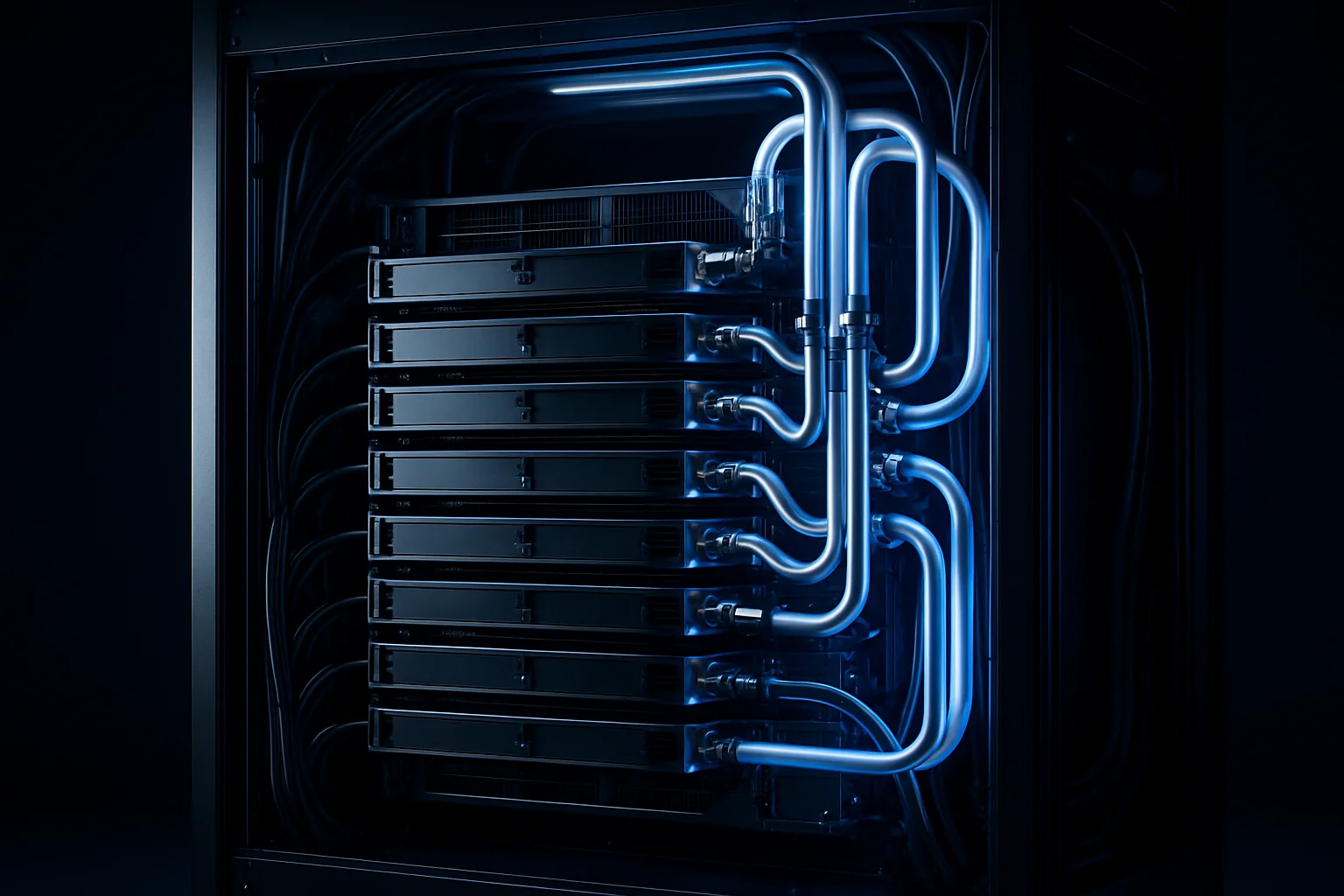
IDACORE East is designed for megawatt-scale AI and HPC colocation with direct-to-chip liquid cooling targeting 120kW per cabinet — dense enough for the GPU generations shipping now and the ones coming after. The design calls for true 2N power: an independent grid source plus gas generation, not a generator sitting idle as backup. Five diverse fiber routes with two separate entry points are planned for the network side.
Phase 1 targets 5MW of IT load across 40 cabinets, with the full build eventually scaling to 20MW. None of this exists yet. It's a design target and a construction timeline, and I'll say that plainly because a site that isn't built yet shouldn't be marketed like it's already running racks. What you're evaluating with an LOI is the engineering plan, the power contract terms, and the delivery date — not a facility you can tour and rack gear into next week.
The efficiency target is worth noting: a PUE around 1.10, with free air cooling available roughly 8 months a year given Eastern Oregon's climate. That directly affects your power bill, since utility costs pass through at cost with no markup on top of the $175/kW/month base rate.
Running the Numbers: Cloud GPU vs. Colocation TCO
Let's take a concrete scenario. Say you need sustained capacity equivalent to 200 H100-class GPUs for a 12-month training and inference workload.
On a major cloud provider, on-demand H100 instances commonly run $2.50–$5.00/GPU-hour depending on the provider and commitment level. Even with a 1-year reserved discount bringing you toward the lower end, 200 GPUs running continuously for 12 months lands well into seven figures — and that's before egress charges on any data movement, which cloud providers bill per-GB with no ceiling.
Colocation flips the cost structure to power draw. A dense GPU cluster at that scale, running in cabinets designed for 120kW density, might draw somewhere in the range of 800kW–1MW depending on your actual hardware mix and utilization — which conveniently lines up with East's 1MW minimum commitment.
| Model | Cost Structure | 12-Month Estimate Driver |
|---|---|---|
| Cloud GPU (on-demand/reserved) | $2.50-$5.00/GPU-hour | Scales with GPU-hours consumed, plus per-GB egress |
| IDACORE East colocation | $175/kW/month + utility pass-through at cost | Scales with power draw, flat and predictable |
The cloud number scales with usage and unpredictability — spin up more inference traffic, pay more, with egress charges that are genuinely hard to forecast. The colocation number scales with power draw you control and can measure with a meter. You know your bill in January before January happens.
This isn't a claim that colocation wins in every scenario. A three-month pilot with unpredictable GPU needs is still better served by cloud elasticity. But sustained, planned training infrastructure running 12+ months is where the flat-rate power model starts saving real money, and that gap widens every month the workload continues.
What Does an LOI Actually Commit You To?
A letter of intent for pre-leasing colocation space is not a lease. It's a documented commitment of intent — typically covering cabinet count, target power draw, and a target delivery window — that lets IDACORE plan build-out capacity against real demand and lets you lock in pricing and priority ahead of general availability. For a site like East that's constructing toward a Q4 2026 target, the LOI stage is when you shape your power commitment (remember, 1MW minimum) and your delivery timeline before racks are welded down and allocated to someone else.
If you're planning a GPU deployment for late 2026 or 2027, the LOI conversation now is the difference between getting the density and power allocation you actually need and taking whatever's left after other tenants have already committed.
What About Private Transport to Other IDACORE Sites?
IDACORE East is designed with private transport available to IDACORE Boise and IDACORE North for customers who need multi-site redundancy or want inference serving closer to end users while training happens at scale in Eastern Oregon. This isn't dark fiber between sites — it's managed private transport, and the distinction matters if you're architecting a topology that assumes point-to-point fiber ownership.
IP transit at East matches pricing across all three IDACORE locations: 100M commits at $170/month, 1G at $600/month, 10G at $2,000/month, and 100G at $11,050/month, all billed on a 95th percentile basis against your committed tier. That's the same transit stack we run out of our own ASN with BGP peering we manage directly — not a resold circuit — at every site, including the one still under construction.
Frequently Asked Questions
Is IDACORE East open for colocation now?
No. IDACORE East is pre-leasing via LOI with a targeted Q4 2026 delivery. It is not built and cannot be occupied today. The LOI process lets you lock in power commitments and pricing ahead of the build, but no cabinets are live yet — unlike IDACORE Boise and IDACORE North, which are both accepting orders now.
What's the minimum power commitment for IDACORE East?
1MW minimum, billed at $175/kW/month base rate plus utility pass-through billed at cost with no markup. This is a different pricing model than IDACORE Boise or North, which bill at $300/kW/month with no minimum commitment.
How does GPU cloud pricing compare to colocation for a year-long training job?
Cloud on-demand H100 pricing typically runs $2.50-$5.00/GPU-hour, scaling with usage and unpredictable egress fees. Colocation bills on flat power draw instead — for sustained 12-month+ workloads, the flat-rate model at $175/kW/month plus at-cost utility pass-through is generally far more predictable and often cheaper at scale.
What cooling and density is IDACORE East designed for?
The site is designed for direct-to-chip liquid cooling supporting up to 120kW per cabinet, with a target PUE around 1.10 and free air cooling available roughly 8 months a year in Eastern Oregon's climate. These are design targets for the Q4 2026 build, not currently operational figures.
Can I get private network connectivity between IDACORE East and IDACORE Boise?
Yes, private transport is planned between IDACORE East and both IDACORE Boise and IDACORE North for multi-site architectures. This is managed private transport, not dark fiber — there is no dark fiber connection between the sites.
If you're scoping a GPU cluster for late 2026 and want to lock in the $175/kW/month base rate and a 1MW power allocation before the site fills up, talk to us about an IDACORE East LOI and we'll walk through the delivery timeline and commitment terms with you directly.