Running GPU clusters on a cloud contract means paying for redundancy you can't verify and power you can't audit. IDACORE East is designed for true 2N power — independent grid source plus gas generation, not generator backup — at $175/kW/month plus utility pass-through billed at cost, 1MW minimum, pre-leasing now for Q4 2026.
What Does "True 2N" Actually Mean at Eastern Oregon?
Most colocation facilities sell you "N+1" and call it redundant. N+1 means one extra UPS module or one extra chiller beyond what you need to run at full load. It's fine for a general-purpose data hall. It is not what you want sitting under a $40M GPU cluster that can't tolerate an unplanned restart.
True 2N is a different architecture entirely. IDACORE East is designed with two complete, independent power paths: a grid utility feed and on-site gas generation, each sized to carry the full IT load on its own. Not a backup generator that spins up after a failure — a second primary source that's live and ready. If one path drops, the other carries the entire facility without a blip. That's the design target for Eastern Oregon, and it's the standard GPU training runs actually need, because a mid-epoch power interruption on a multi-week training job doesn't cost you minutes. It costs you the whole run.
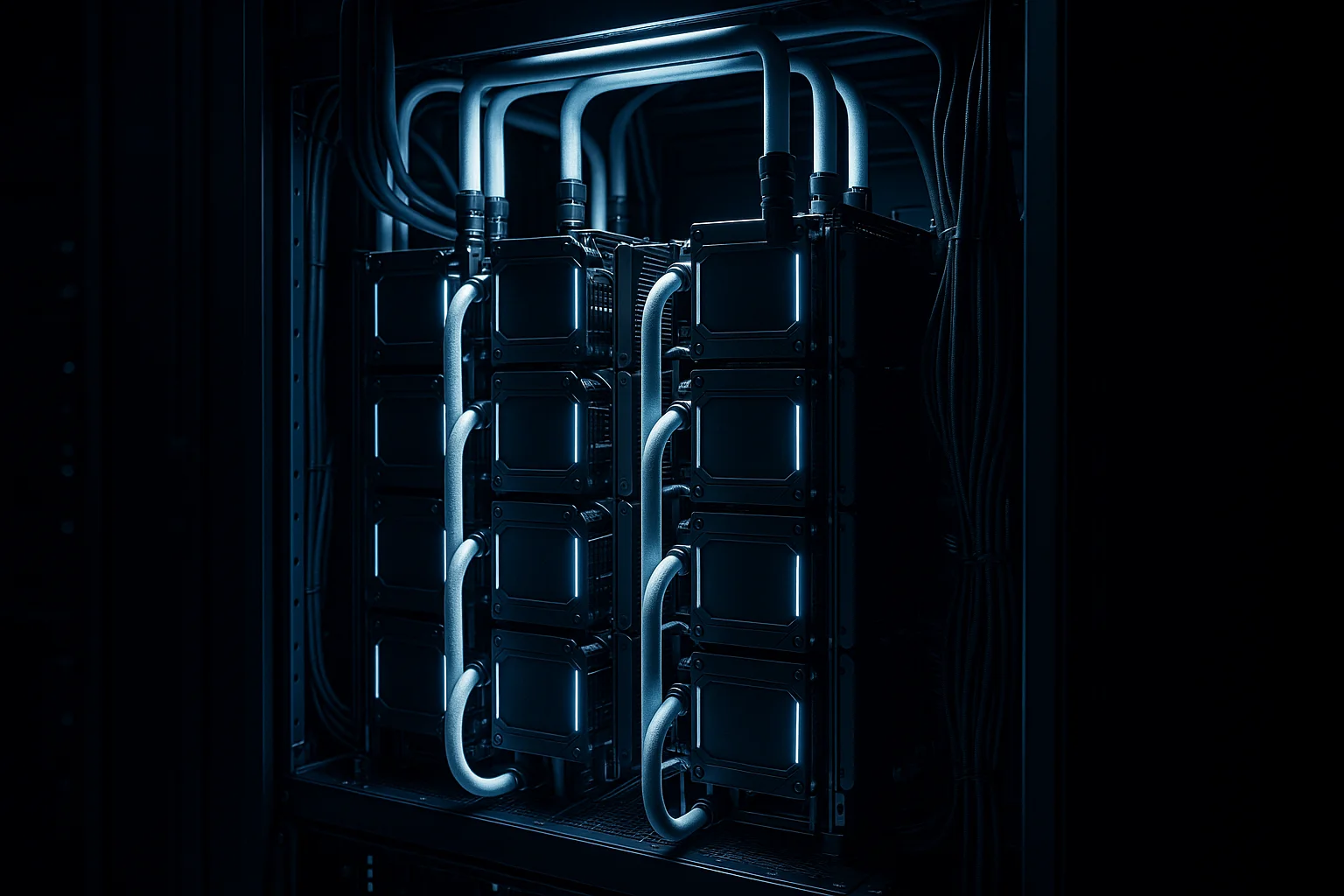
Pair that with direct-to-chip liquid cooling planned at 120kW per cabinet, and you're looking at a facility designed around the actual thermal and power profile of H100 and B200-class clusters, not a retrofitted enterprise hall.
How Does the Pricing Actually Work?
IDACORE East's rate is $175/kW/month base plus utility pass-through billed at cost — no markup on the power itself. That's a 1MW minimum commitment. Compare that to IDACORE Boise and IDACORE North, both at $300/kW/month flat, and you'll notice East is structured differently on purpose: at megawatt scale, the utility rate itself becomes the biggest line item, and Idaho Power's commercial rates (~$0.055/kWh, roughly half the national average) make that pass-through number better than what you'd get folded into a flat per-kW rate almost anywhere else.
Here's the math on a 1MW deployment, assuming full utilization:
- Base: 1,000 kW x $175 = $175,000/month
- Utility pass-through at $0.055/kWh: 1,000 kW x 24 x 30 x $0.055 ≈ $39,600/month
- Total: roughly $214,600/month for 1MW of true 2N GPU-ready colocation
No markup games on the electricity. You see exactly what the utility charged and exactly what you're paying us for infrastructure.
How Does That Compare to a GPU Cloud Contract?
A GPU cloud contract bundles compute, power, cooling, and a margin you can't see into one number per GPU-hour. You don't know what you're paying for power versus what you're paying for the provider's capital recovery. That matters if you're running your own hardware and just need the facility — which is the entire premise of colocating at IDACORE East instead of renting instances.
| Factor | GPU Cloud Contract | IDACORE East (2026) |
|---|---|---|
| Power cost visibility | Bundled, opaque | Separate line: $175/kW/mo + at-cost utility |
| Redundancy architecture | Vendor-defined, rarely disclosed | True 2N: independent grid + gas, disclosed |
| Cooling density | Fixed by vendor's hardware generation | Designed for 120kW/cabinet direct-to-chip |
| Contract flexibility | Often locked to vendor's instance types | You own the hardware, we own the facility |
| PUE efficiency passed to you | Not disclosed | Targeting ~1.10, free air cooling 8 months/year |
If you're running your own GPU fleet — owned or financed — a cloud contract doesn't make sense once you're past a handful of racks. You're paying someone else's margin on top of power you could buy yourself at Idaho Power's commercial rate. At 1MW and above, colocating with transparent pricing almost always wins, and IDACORE's broader positioning (30-40% below AWS/Azure/GCP on comparable workloads) holds here too.
What's the Timeline and What's Already Committed?
IDACORE East is in pre-leasing via LOI today, with Phase 1 targeting 5MW of IT load across 40 cabinets, scaling to a full 20MW site. Q4 2026 is the target for Phase 1 availability. That's not a vague "coming soon" — it's a defined phase with a defined density target, and the LOI process exists specifically so operators planning 2027 training infrastructure can lock in capacity and pricing before the site is live.
The site's network design includes 5 diverse fiber routes across 2 separate physical entry points, which matters for anyone running distributed training across multiple sites — you don't want your redundant fiber paths sharing a single conduit. Private transport is also planned between IDACORE East and IDACORE Boise for operators who want a Pacific Northwest footprint spanning both facilities. There is no dark fiber link between the sites today, and we won't tell you otherwise.
Who Should Be Signing an LOI Right Now?
If your GPU training infrastructure plans extend into 2027, the math on waiting versus locking in capacity now favors moving early. Megawatt-scale, true 2N GPU colocation is a limited product in the Pacific Northwest — Eastern Oregon has the land, the power availability, and the climate for free air cooling 8 months a year, but that capacity gets allocated to whoever signs first. Companies running sustained training workloads, not just inference bursts, are the clearest fit: the economics of owning hardware and colocating only make sense once your utilization is high enough that a flat per-kW rate beats a per-GPU-hour cloud bill.
If you're still inference-only at low utilization, a cloud contract might still make sense for now. But if you're planning a dedicated training cluster at 500kW or above, the LOI process at IDACORE East is built for exactly that conversation.
Frequently Asked Questions
What is true 2N power and how is it different from N+1?
True 2N means two complete, independent power paths — IDACORE East is designed with an independent grid feed plus on-site gas generation, each capable of carrying full IT load alone. N+1 means one spare component beyond minimum need, with a single primary path. If that primary fails, N+1 facilities experience a transfer event; true 2N facilities don't, because the second path is already live, not standby.
How much does IDACORE East cost per kW?
$175/kW/month base rate plus utility pass-through billed at cost with no markup, with a 1MW minimum commitment. On a 1MW deployment at Idaho Power's commercial rate of roughly $0.055/kWh, total monthly cost (base plus pass-through) comes to approximately $214,600, fully itemized between facility fee and electricity cost.
When will IDACORE East be available for GPU colocation?
IDACORE East is pre-leasing now through signed LOIs, with Phase 1 targeting Q4 2026 at 5MW of IT load across 40 cabinets. The full build-out plan scales to 20MW. It is not operational today — capacity is being allocated through the pre-leasing process ahead of construction completion.
What density does IDACORE East support per cabinet?
IDACORE East is designed for direct-to-chip liquid cooling supporting up to 120kW per cabinet, sized around current and next-generation GPU training hardware like H100 and B200-class systems. This is a design target for the Q4 2026 Phase 1 buildout, not an existing live capability.
Is there a dark fiber connection between IDACORE East and IDACORE Boise?
No. Private transport is planned between IDACORE East and IDACORE Boise, but no dark fiber link exists between the sites currently. IDACORE East itself is designed with 5 diverse fiber routes across 2 separate physical entry points for its own network redundancy.
Megawatt-scale GPU training infrastructure doesn't wait for you to finish due diligence after the fact — if your 2027 roadmap includes dedicated training clusters, the time to lock in true 2N capacity and pricing at Eastern Oregon's at-cost utility rate is now, before Phase 1 allocates. Talk to our team about an LOI for IDACORE East.