If you're planning a GPU cluster for IDACORE East, size it around 120kW per cabinet, direct-to-chip liquid cooling, and a 1MW facility minimum. That's roughly 8 cabinets at full density, or more cabinets at partial load. Pricing is $175/kW/month base plus utility pass-through at cost — no markup, no surprises.
Why 120kW Per Cabinet Instead of 15kW?
Traditional colocation was built for 5-15kW cabinets because air cooling has a ceiling. Push much past 20kW in an air-cooled cabinet and you're fighting physics — hot aisle containment only gets you so far before you need more CFM than most facilities can move economically.
GPU clusters blew past that ceiling years ago. An NVIDIA H100 SXM draws around 700W per GPU. Pack 8 into a server and you're at 5.6kW before you count networking, CPUs, or storage. A single rack of these servers can hit 40-60kW without trying. Next-gen platforms — GB200 NVL72 and beyond — are designed around rack-scale power in the 100-140kW range as the default, not the exception.
IDACORE East is being designed around this reality from the ground up: 120kW per cabinet using direct-to-chip liquid cooling. That's not a retrofit number. It's the design target for the facility because that's where GPU density is heading, and we're not interested in building something that's obsolete before it opens.
What Does Direct-to-Chip Actually Cool?
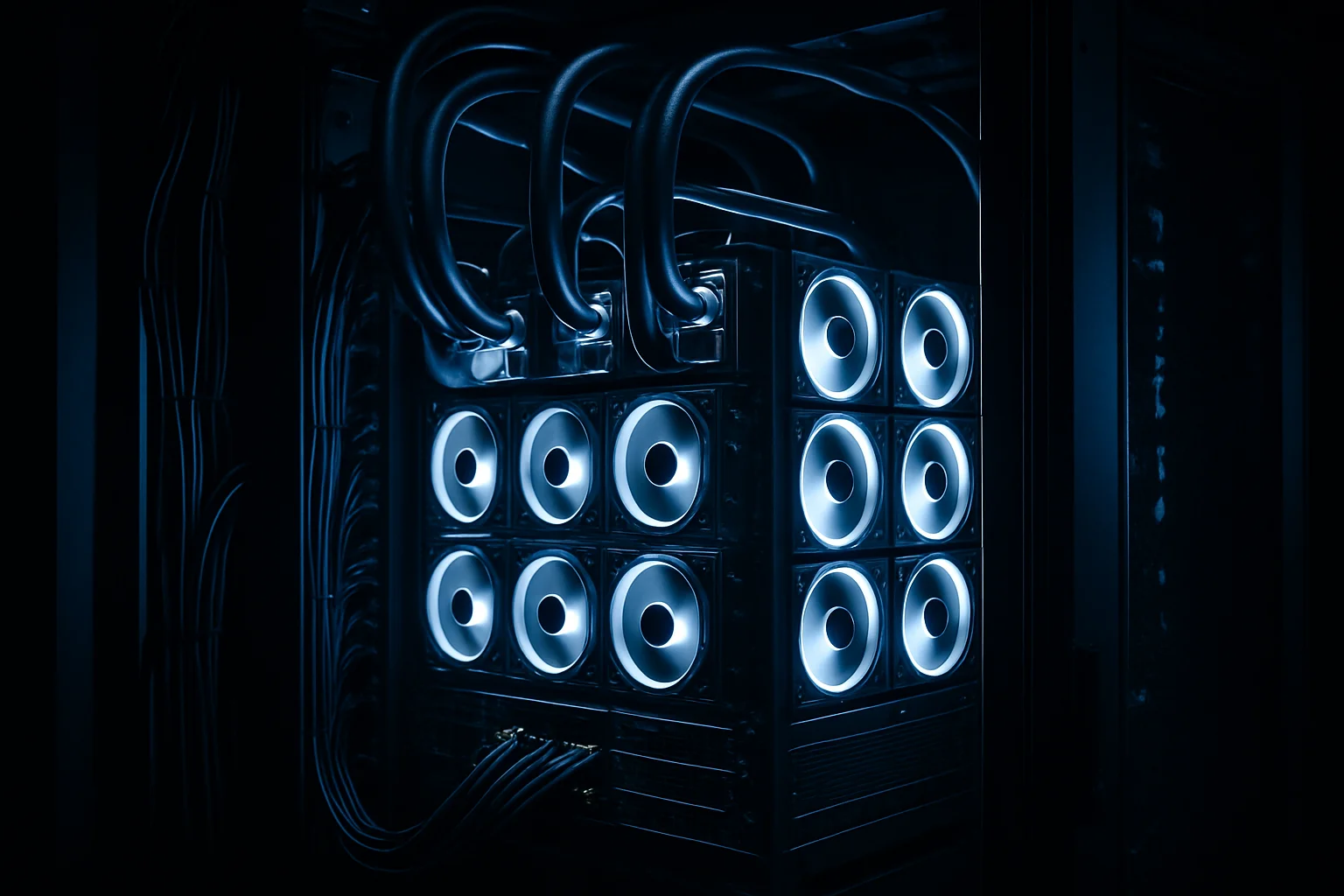
Direct-to-chip liquid cooling routes coolant through cold plates mounted directly on the GPU and CPU dies — the components generating the most heat per square inch. It doesn't replace all cooling; you still need some air handling for memory, VRMs, and other board components. But it pulls the majority of thermal load off the air system entirely, which is what makes 120kW in a single cabinet workable instead of theoretical.
The facility design targets a PUE around 1.10. For comparison, a legacy air-cooled data center running in the 1.4-1.6 PUE range is spending 40-60% more electricity just moving heat around, on top of whatever the compute itself draws. At megawatt scale, that gap is real money every month, not a rounding error.
How Do You Size a Cluster Against a 1MW Minimum?
IDACORE East's colocation minimum is 1MW of IT load. Before you sign an LOI, work backward from your actual cluster plan, not from what sounds impressive.
Say you're deploying 64 H100 GPUs across 8 servers per rack, 4 racks total. At roughly 120kW per cabinet running near full GPU utilization, that's 480kW of IT load — under the 1MW minimum. You'd either need to scale to 8-9 full cabinets, or negotiate a phased ramp if your roadmap gets you there within a reasonable window.
Here's a rough sizing table for planning purposes:
| Cabinets at 120kW | Total IT Load | Approx. GPU Count (8x H100/server, 4 servers/cabinet) | Monthly Power (base rate only) |
|---|---|---|---|
| 4 | 480kW | ~128 GPUs | $84,000 |
| 8 | 960kW | ~256 GPUs | $168,000 |
| 9 | 1.08MW | ~288 GPUs | $189,000 |
That base rate figure is $175/kW x total kW — utility pass-through is added at cost on top, no markup. Idaho Power and regional Eastern Oregon utility rates run well under national averages, so the pass-through piece is a smaller number than most teams expect coming from Northern Virginia or Silicon Valley power pricing.
What About Power Redundancy for Training Workloads?
Training runs that take weeks don't tolerate power interruption gracefully — a mid-epoch outage can cost you days of compute, not minutes. IDACORE East is designed around true 2N power: an independent grid source plus gas generation as a second independent path, not a generator sitting idle as backup to a single utility feed. That's a meaningful design distinction. Generator-as-backup means you still have a single point of failure until the generator spins up and takes load. Two independent sources means neither is "backup" — either can carry the full load on its own.
Network design follows the same logic: 5 diverse fiber routes through 2 separate physical entry points, so a single fiber cut or a backhoe at one entry point doesn't take the site offline.
Free Air Cooling and Why It Matters for Your Bill
Eastern Oregon's climate supports free air cooling roughly 8 months a year, which is baked into the ~1.10 PUE target. Compare that to Phoenix or Dallas colocation, where mechanical cooling runs close to year-round and PUE numbers routinely sit north of 1.4 for GPU-dense environments. Lower PUE isn't a marketing footnote — it directly reduces your utility pass-through since you're not paying to cool the same watt twice.
What Should You Confirm Before Signing an LOI?
IDACORE East is pre-leasing now, targeting Q4 2026 for Phase 1 — 5MW of IT load across 40 cabinets, with the full site designed for 20MW. Before you commit:
- Confirm your actual kW-per-cabinet need, not a theoretical max. If you're running mixed training and inference workloads, average utilization matters more than peak GPU TDP.
- Model your utility pass-through using current Eastern Oregon commercial rates — ask for the actual pass-through structure in writing, since it's billed at cost with no markup.
- Check your timeline against Q4 2026. If you need capacity in the next two quarters, Phase 1 delivery timing needs to work for your roadmap, not the other way around.
- Ask about private transport to IDACORE Boise. East is designed with private transport connectivity to Boise for teams that want DR or hybrid deployment between sites — this is not shared dark fiber, it's dedicated transport built for that purpose.
An LOI at this stage locks in pricing and position in the Phase 1 build queue. It doesn't lock you into inflexible terms — but it does mean your sizing math needs to be close enough that you're not renegotiating cabinet count six months before delivery.
Frequently Asked Questions
What is the minimum colocation commitment at IDACORE East?
IDACORE East requires a 1MW minimum IT load commitment. Pricing is $175/kW/month base rate plus utility pass-through billed at cost with no markup. At 120kW per cabinet, 1MW works out to roughly 8-9 cabinets depending on actual load distribution.
Is IDACORE East available for colocation now?
No. IDACORE East is in pre-leasing via LOI, with Phase 1 targeting Q4 2026 — 5MW of IT load across 40 cabinets. The full site is designed for 20MW. IDACORE Boise and IDACORE North are both live today for colocation orders.
What cooling does IDACORE East use for GPU clusters?
IDACORE East is designed around direct-to-chip liquid cooling supporting up to 120kW per cabinet, with a target PUE around 1.10. The design also uses free air cooling for approximately 8 months a year in Eastern Oregon's climate to reduce mechanical cooling load.
How does IDACORE East's power redundancy work?
IDACORE East is designed with true 2N power — an independent grid source plus gas generation as a second independent source, not a generator serving as backup to a single feed. Networking uses 5 diverse fiber routes through 2 separate entry points for physical path redundancy.
Can IDACORE East connect to IDACORE Boise for hybrid deployment?
Yes. IDACORE East is designed with private transport connectivity to IDACORE Boise for teams running hybrid or DR architectures between sites. This is dedicated private transport, not shared dark fiber between the two locations.
If you're modeling a GPU cluster for 2026 and want real numbers instead of theoretical density, talk to our team about IDACORE East pre-leasing — we'll walk through your kW-per-cabinet math against the 1MW minimum before you put anything in writing.