For sustained AI training workloads running days or weeks at a time, GPU colocation at $250/kW beats cloud GPUs on total cost — typically by 40–60% at scale. Cloud GPU pricing is engineered for burst compute, not continuous utilization. Once your cluster runs above roughly 60–70% utilization for more than a few weeks per month, dedicated colocation wins on economics every time.
Why Cloud GPU Pricing Falls Apart at Scale
Cloud providers aren't hiding anything. Their GPU instance pricing is transparent, and for what it is — on-demand access to hardware you don't have to buy, rack, or maintain — it's reasonable. The problem is that AI training doesn't work the way cloud pricing is designed.
Training a large model isn't a burst workload. It's a sustained, high-utilization job that runs for days, sometimes weeks, and demands consistent performance from the same hardware throughout. Cloud GPU instances are priced for the opposite use case: intermittent jobs where you pay a premium for flexibility.
Take AWS p5.48xlarge — 8x H100 SXM5 GPUs, 192 vCPUs, 2TB RAM. On-demand pricing runs around $98/hour as of early 2025. That's roughly $70,000/month per instance if you run it continuously. A modest 10-node training cluster hits $700,000/month. One-year reserved pricing cuts that by about 30%, but you're still looking at $490,000/month — and you've now committed to a year of cloud spend with no hardware to show for it.
At IDACORE East's $250/kW all-in rate with a 1MW minimum, that same compute footprint costs $250,000/month. Everything included: power, cooling, cross-connects, facility. No egress fees when you're pulling training data from your own storage. No surprise bills when your gradient checkpoints saturate the network.
That's not a marginal difference. That's $2.9M in annual savings on a single training cluster.
What "All-In" Actually Means at $250/kW
The phrase "all-in" does a lot of work in data center pricing, so let's be specific about what IDACORE East's rate covers.
$250/kW/month includes power delivery to your cabinet, cooling (direct-to-chip liquid at up to 120kW per cabinet), facility overhead, and network connectivity. You're not getting a base rate and then discovering separate line items for power distribution units, cooling infrastructure fees, or "facility services charges" — the games that inflate per-kW pricing at traditional facilities.
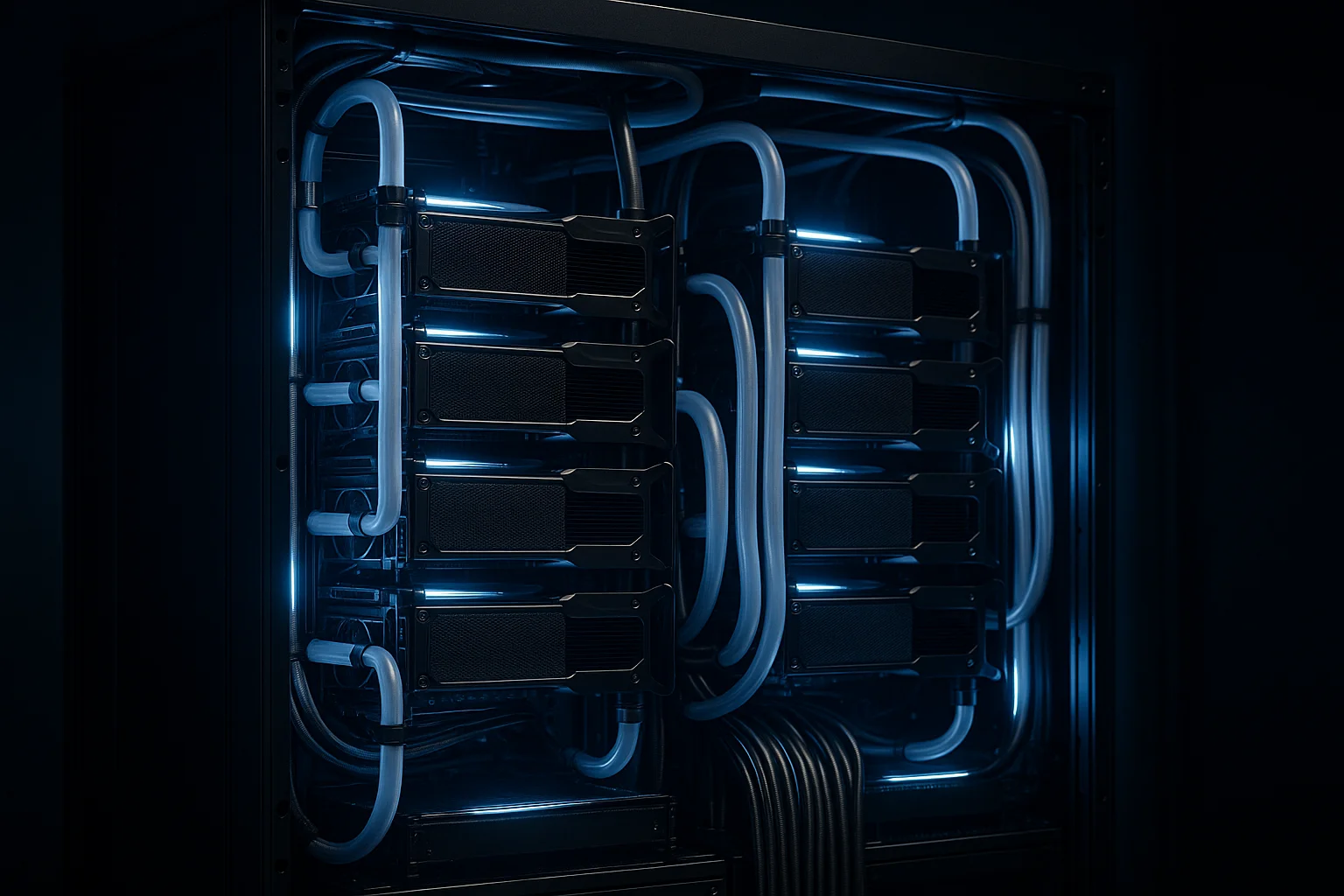
The 120kW-per-cabinet liquid cooling spec matters more than it might look on paper. A standard DGX H100 system draws about 10.2kW. Stack eight of them in a cabinet with networking and you're well past what air cooling can handle. Most enterprise data centers — including a lot that market themselves as "AI-ready" — cap out at 15–20kW per cabinet with air. You end up spreading your cluster across more cabinets, buying more cross-connects, and dealing with more inter-cabinet latency. Direct-to-chip liquid cooling at 120kW per cabinet means your GPU cluster stays dense and your interconnects stay short.
The power architecture matters too. IDACORE East runs true 2N power: an independent grid source plus continuous gas generation — not a generator that spins up during an outage. There's no transfer time, no UPS bridge window. For a training job that's been running for 11 days, a 200-millisecond power glitch can corrupt a checkpoint and cost you a full day of recompute. True 2N eliminates that failure mode.
The Real Cost Comparison: A 40-Cabinet H100 Cluster
Let's run the numbers on a realistic Phase 1 deployment at IDACORE East — 40 cabinets, roughly 1MW of IT load.
| Cost Category | Cloud (AWS p5, 1-yr reserved) | IDACORE East Colocation |
|---|---|---|
| Monthly compute/power cost | ~$490,000 | $250,000 |
| Egress fees (100TB/month) | ~$9,000 | $0 |
| Hardware ownership | None | Yours |
| Hardware residual value (3 yr) | $0 | ~$2M+ |
| Annual total (Year 1) | ~$5.99M | $3.0M |
| Annual total (Year 2) | ~$5.99M | $3.0M |
The hardware ownership point is one that finance teams often miss in the initial analysis. When you colocate, you own the GPUs. H100s aren't depreciating to zero — they hold value. At year three, your cluster has a residual value that partially offsets the original capital expenditure. Cloud spend disappears entirely.
The egress line is worth calling out separately. Training pipelines move data. A lot of it. Checkpoints, datasets, validation outputs — if your storage lives in the same cloud where you're renting GPUs, egress might look manageable. The moment you're pulling training data from on-premises storage or a different provider, cloud egress costs compound fast.
Why Eastern Oregon Makes Geographic Sense for AI Infrastructure
The facility location isn't arbitrary. Eastern Oregon sits outside the Pacific Coast seismic and wildfire risk zones that affect coastal data centers from California to Washington. It's geographically separated from the population centers that drive up power costs, which is why Idaho Power commercial rates run around $0.055/kWh — roughly half the national average. That power cost is baked into the $250/kW rate.
Five diverse fiber routes with two separate entry points mean network redundancy isn't a marketing claim — it's physical infrastructure. Private transport to IDACORE Boise and IDACORE North gives you a multi-site Pacific Northwest footprint under one operator relationship. If you need compliance staging in Boise or disaster recovery in Coeur d'Alene, those aren't separate vendor conversations.
The target PUE of approximately 1.10 is achievable because Eastern Oregon's climate allows free air cooling for roughly eight months per year. For AI training workloads that generate enormous heat loads, a low PUE isn't just a green credential — it's a direct cost factor. Every watt you spend moving heat is a watt you're paying for that isn't doing compute.
What the Cloud Is Still Good For
I'll be direct about this: cloud GPUs aren't the wrong answer for every workload. If you're running inference at unpredictable volume, doing model evaluation runs that last hours rather than weeks, or you genuinely can't predict your compute needs six months out, cloud burst capacity makes sense. The flexibility premium is real and sometimes worth paying.
Cloud also makes sense during hardware procurement cycles. If you're waiting on H200 or Blackwell delivery, spinning up cloud instances to keep training pipelines moving is a reasonable bridge strategy. We see customers use IDACORE Boise for staging and development while larger deployments at IDACORE East are being built out.
The crossover point is roughly this: if your GPU cluster runs above 65% average utilization for more than three weeks per month, colocation wins on economics. Below that threshold, or for workloads with genuinely unpredictable schedules, cloud flexibility has value. Most serious training workloads cross that threshold easily — that's what makes them serious training workloads.
Frequently Asked Questions
How much does GPU colocation cost compared to AWS or Azure in 2026?
At IDACORE East's $250/kW all-in rate, a 1MW AI training cluster runs roughly $250,000/month. Equivalent H100 capacity on AWS p5.48xlarge instances runs $500,000–$700,000/month for sustained workloads. The gap widens the longer your training runs — cloud GPU pricing is designed for burst use, not weeks-long training jobs.
What power density does an H100 or H200 cluster actually need?
A standard DGX H100 system draws about 10.2kW. A full 8-GPU H100 server with NVLink typically runs 6–10kW depending on utilization. At rack scale, dense GPU clusters commonly require 40–120kW per cabinet. IDACORE East supports up to 120kW per cabinet with direct-to-chip liquid cooling — most traditional data centers cap out at 10–20kW per cabinet.
Where is IDACORE East located, and when does it open?
IDACORE East is in Eastern Oregon, currently in pre-leasing via Letter of Intent. Phase 1 targets Q4 2026 with 5MW IT load across 40 cabinets. The full site scales to 20MW. Private transport is available to IDACORE Boise and IDACORE North, giving customers a multi-site Pacific Northwest footprint with a single operator relationship.
What does '2N power' actually mean for an AI training facility?
True 2N power means two completely independent sources — in IDACORE East's case, a separate grid feed plus on-site gas generation that runs continuously, not as emergency backup. If grid power fails, generation was already running. There's no transfer time, no UPS bridge, no gap. For GPU clusters running multi-week training jobs, any power interruption can corrupt a checkpoint and cost days of compute.
Can I start with less than 1MW at IDACORE East?
IDACORE East's minimum commitment is 1MW, which positions it for serious AI infrastructure deployments rather than small-scale GPU experiments. If you need colocation for smaller GPU workloads today — a few cabinets, a test cluster — IDACORE Boise is live now, accepts 1U minimums, and can host GPU servers while your larger deployment plans develop. Contact us to discuss a phased approach.
IDACORE East is currently accepting Letters of Intent for Phase 1 capacity — 40 cabinets, 5MW IT load, targeting Q4 2026. If you're modeling a training cluster and want real numbers against your specific hardware configuration, we'll run the comparison with you directly. No sales deck, no discovery call theater — just infrastructure people talking through your actual workload. Talk to our team about your AI infrastructure requirements.