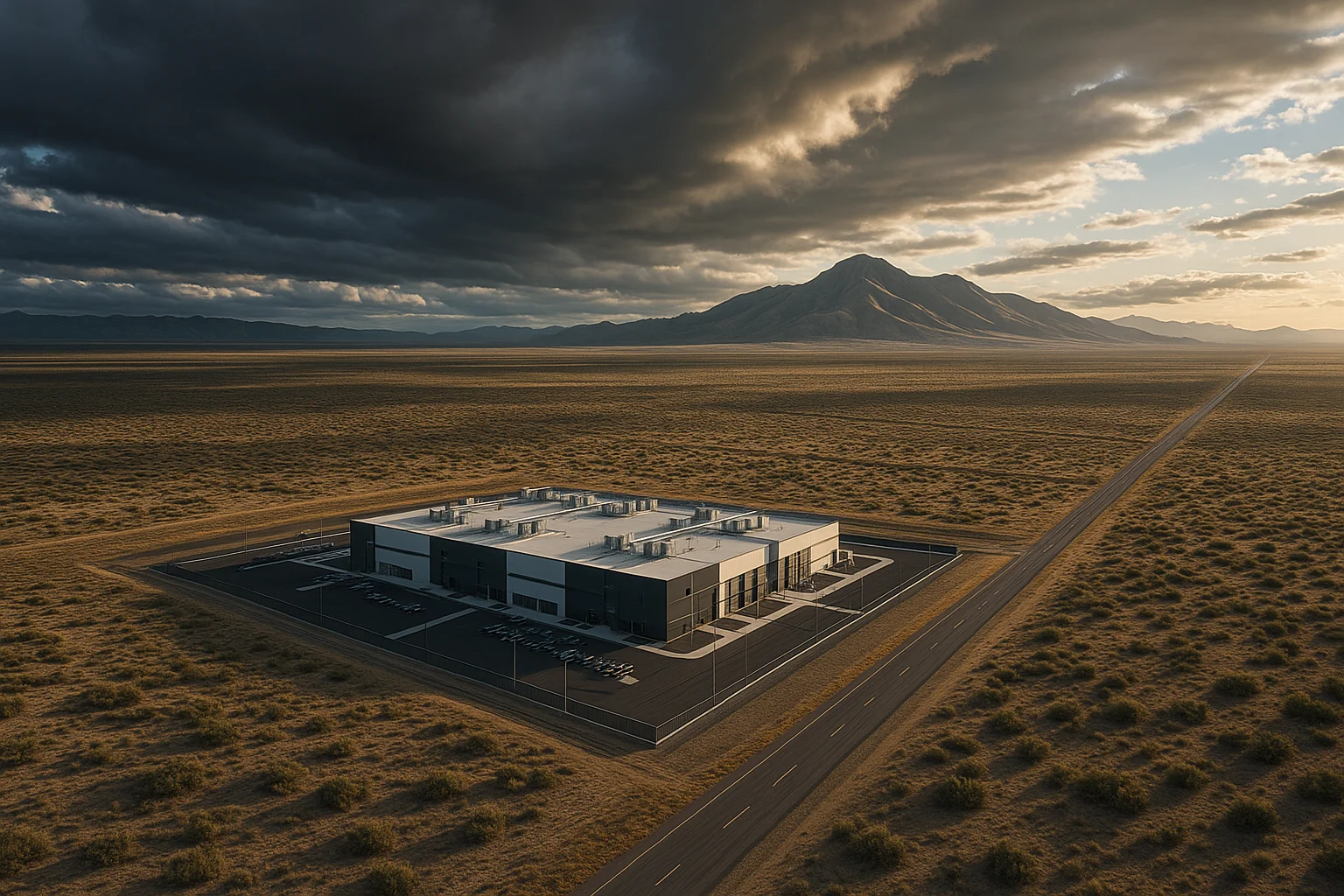
Spokane businesses looking for disaster recovery don't need to ship gear to Seattle. IDACORE North, at 2115 N Government Way in Coeur d'Alene, sits roughly 45 minutes from downtown Spokane, offers per-U and full cabinet colocation at $300/kW/month, and is open for active orders today.
Why Does Distance Matter for a DR Site?
Every DR plan makes a tradeoff between geographic separation and how fast you can get a human on-site when something breaks. Seattle checks the separation box for a Spokane company — it's about 280 miles away. But that distance cuts both ways. If your primary site goes down and you need to physically swap a drive, reseat a card, or walk a new switch into a rack, you're looking at a 5-hour drive each way, more with I-90 traffic through the Cascades in winter, and that's assuming the pass isn't closed.
Coeur d'Alene solves the real problem: enough distance that a Spokane-area outage — a fiber cut, a power event, a building fire — doesn't touch your DR site, but close enough that "we need someone in the rack in an hour" is actually true. Forty-five minutes on I-90 East. No mountain pass. No coastal traffic. That's the difference between DR that works on paper and DR that works at 2 AM.
There's also a seismic angle worth naming directly. Seattle and the I-5 corridor sit in an active earthquake zone with real wildfire smoke exposure in summer. Coeur d'Alene and Boise sit outside both risk profiles. If your DR strategy is "replicate to the coast," you've bought geographic separation for your data but kept both sites in the same regional risk basket for infrastructure disruption — power grid strain, wildfire-driven air quality shutdowns, transportation bottlenecks.
What Does "Regional Redundancy" Actually Require?
Real redundancy means your primary and DR sites don't share failure modes. Ask yourself: do both sites draw from the same power grid interconnect? Same regional fiber backbone? Same weather system? If a Spokane ISP has its primary infrastructure in-market and its DR sitting on the same power grid segment or same fiber route out of the region, that's not redundancy — that's the illusion of it.
IDACORE North runs on Idaho Power's grid, physically separate from Spokane's utility infrastructure, and connects through a different set of carrier routes than what serves most Spokane-based businesses natively. You get actual electrical and network path diversity, not just a different street address.
What Does IDACORE North Cost Compared to a Seattle DR Site?
Power pricing at North matches Boise exactly: $300/kW/month, billed on actual draw, no minimum commitment. A 1U server pulling 150W costs you $45/month in power. A half-cabinet running 2kW runs $600/month. There's no per-rack-space fee stacked on top — you pay for the power you use.
Compare that to a typical Seattle-area colocation footprint, where market power costs and real estate premiums push per-kW rates 40-60% higher in many facilities, and you're also paying Seattle labor rates for any remote-hands work when you can't make the drive.
| Factor | IDACORE North (CDA) | Typical Seattle Colo |
|---|---|---|
| Distance from Spokane | ~45 minutes | ~4.5-5 hours |
| Power pricing | $300/kW/month, no minimum | Often $400-500+/kW/month |
| Contract term | 12 months standard | Often 36 months |
| Shared risk with Spokane grid/fiber | No | Depends on route |
| Seismic/wildfire exposure | Low | Elevated (I-5 corridor) |
| Remote-hands response for true emergency | Same-day drive feasible | Next-day flight/drive typical |
IP transit pricing is also identical to Boise: 1G commit at $600/month ($0.60/Mbps), 10G at $2,000/month ($0.20/Mbps), billed on 95th percentile usage. We run this transit ourselves — our own ASN, our own BGP sessions, peering relationships we built from years running an ISP at the Seattle Internet Exchange. That matters for DR specifically: your failover site needs traffic engineering that's aware of your primary site's routes, not a reseller repackaging someone else's transit contract.
What Does a Real DR Deployment Look Like at North?
Take a Spokane-based healthcare SaaS company running its primary stack in a local data center. Their compliance requirements (HIPAA) mean they need a documented, geographically separate DR site with equivalent security certifications. They deploy a half-cabinet at IDACORE North: a couple of application servers, a replicated database node, and a small firewall/router stack — roughly 2.5kW total draw.
Monthly cost: $750 in power, plus a 1G transit commit at $600/month for replication traffic and failover routing. That's $1,350/month for a DR footprint with sub-hour physical access, a facility that's SOC 2 Type II and HITRUST CSF certified, and 12-month contract terms instead of the 36-month lock-in most enterprise colocation providers push. If they'd built the same DR footprint into a Seattle facility, they'd likely pay more per kW, sign a longer contract, and accept that any hardware failure during a real disaster means a same-day flight instead of a same-day drive.
Does IDACORE North Meet Compliance Requirements for DR?
Yes. IDACORE North operates under the same operator and compliance backbone as IDACORE Boise. Facilities across IDACORE are built to support SOC 2 Type II, PCI DSS, NIST 800-53, SSAE-16, and HITRUST CSF workloads, which covers the audit trail most Spokane-area healthcare, financial, and public sector organizations need for a documented DR plan. Data stays in Idaho — it doesn't cross state lines, which simplifies data residency conversations for regulated industries compared to routing DR traffic to Washington or further afield.
What About Network Path Diversity?
IDACORE North is on-net with the same carrier ecosystem strategy as Boise, giving you multiple physical fiber paths rather than a single upstream dependency. For a DR site, that matters more than most buyers initially realize — if your primary site's transit and your DR site's transit both ride the same physical conduit at some point between Spokane and wherever you've parked your failover gear, you've got a single point of failure disguised as redundancy. Path diversity out of Coeur d'Alene avoids that trap.
Frequently Asked Questions
How far is IDACORE North from Spokane?
IDACORE North, located at 2115 N Government Way in Coeur d'Alene, Idaho, is approximately 45 minutes from downtown Spokane via I-90 East. That's close enough for same-day remote-hands response during an emergency, but far enough to sit outside Spokane's local power grid and fiber failure zones.
What does colocation cost at IDACORE North?
Power is billed at $300/kW/month based on actual draw, identical to IDACORE Boise pricing, with no minimum power commitment. A 1U server pulling 150W costs about $45/month. Per-U and full cabinet options are both available, and contracts run 12 months standard rather than the 36-month terms common at enterprise facilities.
Is IDACORE North a good DR site for Spokane healthcare or financial companies?
Yes. The facility supports compliance-ready workloads under SOC 2 Type II, PCI DSS, NIST 800-53, SSAE-16, and HITRUST CSF standards, and Idaho data residency means information doesn't cross state lines. Combined with 45-minute physical access from Spokane, it fits documented DR requirements for regulated industries better than a distant coastal option.
How does IDACORE North compare to a Seattle DR site?
IDACORE North offers lower power costs, shorter 12-month contracts versus typical 36-month terms, and a 45-minute drive from Spokane versus a 4.5-5 hour drive to Seattle. It also sits outside the seismic and wildfire risk zones affecting the I-5 corridor, giving you real infrastructure risk separation, not just distance on a map.
Does IDACORE North offer its own IP transit, or is it resold?
IDACORE runs its own ASN and BGP peering at all facilities, including North, built by an operator team with direct experience running an ISP and peering at the Seattle Internet Exchange. Transit is priced by committed bandwidth — $600/month for 1G, $2,000/month for 10G — billed on 95th percentile usage, not resold from a third-party provider.
If your Spokane infrastructure has a DR plan that depends on a flight to Seattle, it's time to rethink the distance-versus-risk math — talk to our team about deploying at IDACORE North and get a DR footprint that's 45 minutes away instead of half a day.